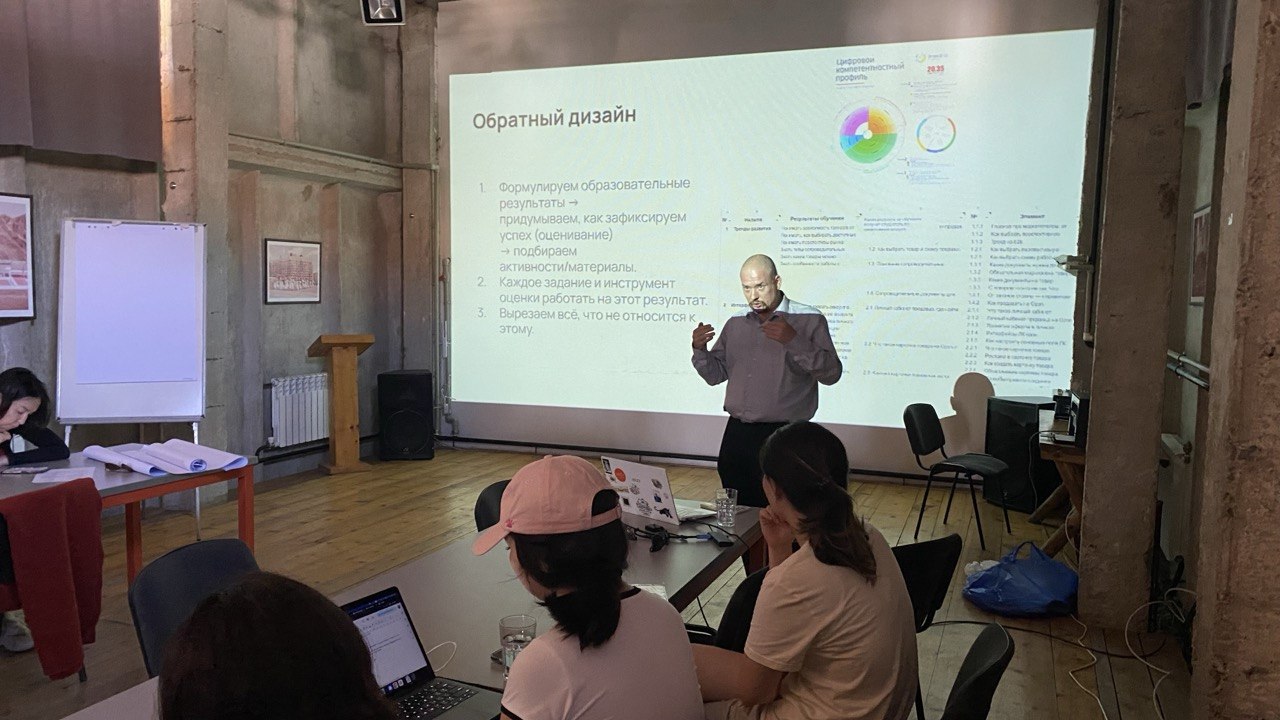
Founder's track record: 75+ universities via University 20.35
Training adapted to real faculty tasks: lesson prep, grading, and restructuring assessment in the age of AI.
Book a trainingStudents already use AI — 69% for problem-solving. You either manage this process, or it manages you. Hands-on training in 4 hours: from zero to ready-made scenarios.
Most faculty use AI to reproduce old practices — but they need to build new ones. 4-hour hands-on training: ChatGPT, NotebookLM, Perplexity for lesson prep and restructuring assessment. Founder's track record: 75+ universities via University 20.35.
Training adapted to real faculty tasks: lesson prep, grading, and restructuring assessment in the age of AI.
Book a trainingNew standards require digital competencies, accreditation in 1-2 years. Most instructors don't use AI, and those who tried just reproduce old practices in a new tool. Free 2-hour webinars don't solve the problem.
69% of students use AI for studying, 61% for note-taking. The gap between students' and faculty's digital skills undermines authority and devalues grades.
Real detector accuracy is 50-80%, not the claimed 99%. False positives up to 50%. Vanderbilt adopted and abandoned them. The answer is not to ban AI, but to restructure assessment.
AI in education evolves through three stages — most universities are stuck at the first:
This training covers stage 1. For stage 2 — Flipped Classroom. For stage 3 — Adaptive Programs.
Faculty spend 4–5 hours per week on routine tasks that AI can cut dramatically: preparing materials, literature search, creating tests, fact-checking. Yet most only use ChatGPT — and only for text generation. In our training, we teach a three-tool workflow where each tool serves a distinct purpose:
Every participant leaves with ready-made scenarios for their subject and prompt templates they can use in the very next class.
87% of students at leading universities use AI for studying, while only 16% of faculty apply AI in teaching. Just 6% of educators believe their institution has provided sufficient resources for AI literacy (Global AI Faculty Survey 2025). Meanwhile, 80% of faculty say they simply don't understand how to apply AI in their discipline. The problem isn't resistance — it's a lack of practical training. That's why our training is structured as a workshop, not a lecture: every participant works with their own subject and leaves with ready-made scenarios for the next class.
Universities that rely on AI detectors face three problems. First, real accuracy: a 2026 study found false positive rates of 43–83% on authentic student writing. Second, bias: for non-native English speakers, false positives reach 61%. Third, accuracy drops to 60–80% on paraphrased text. A telling case: at UC Davis, 17 students were flagged — manual review revealed 15 of 17 were false positives. The answer isn't banning AI but restructuring assessment: oral exams, task formulation defense, case analysis. In our training, we walk faculty through these alternative formats and help them adapt assessments for their specific courses.
Accreditation in a year, must demonstrate digital transformation, but 60% of faculty resist
SolutionSystematic training after which faculty actually start using AI. With methodology materials and templates
Administration demands AI, but I don't know where to start. I've seen ChatGPT, but how do I use it in class?
Solution4 hours of practice — leave with ready scenarios for your subject. No prompt engineering required
Need an AI literacy program for faculty, but no in-house expertise
SolutionReady module for PD program integration. Train-the-trainer: your methodologists can deliver independently
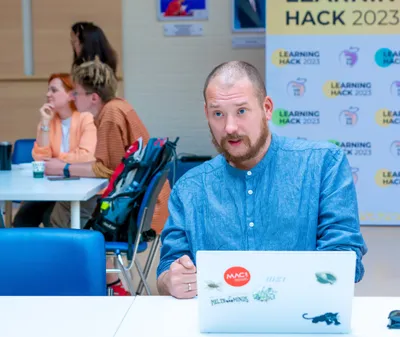
Trainer
Founder of EdUnit, HSE University graduate (philosophy). Ex-Director of Educational Intensives at University 20.35, worked with 75+ universities. Conducts AI trainings for faculty and methodologists. Speaker at 10+ conferences on AI and education.
Assess current AI literacy level across faculty, identify priority departments and courses
Hands-on with ChatGPT, NotebookLM, Perplexity, NanoBanana using participants' own materials. Everyone works with their subject
We deliver prompt templates, grading rubrics, and classroom scenarios. Ready to use immediately
Post-training support: Q&A, case analysis, help integrating AI into specific courses
Prices are indicative. Final cost confirmed in contract.
AI test generator aligned with Bloom's taxonomy. Faculty who completed the training can immediately start creating tests from their materials — 15 questions in 2 minutes instead of 2 hours.
Try QuantaQuizAI tools reach their full potential in the flipped classroom: students prepare independently with AI, while class time is used for practice and discussion.
Learn about flipped classroomAI changes not just tools but methodology. Project-based learning is a model where AI becomes the student's assistant, not a replacement for thinking.
Learn about PBL consultingTest from any material in 2 minutes instead of 2 hours. AI generation aligned with Bloom's taxonomy, unique variants, instant grading — in Russian.
Step-by-step flipped classroom implementation: lesson design, faculty resistance management, QuantaQuiz for check-ups. IUCA case. Results in one semester.
PBL consulting for universities: curriculum audit, faculty facilitation training, project assessment rubrics. Founder's track record: 75+ universities via University 20.35. Results in 1 semester.